

Long ago, when the veil between heaven and earth seemed thin as the morning mist over the hills of Judea, a small company was gathered on the Mount of Olives. The air carried the scent of the branches and the distant sounds of the temple, and their hearts bore fresh memories of the one who had walked with them through valleys of shadow and summits of glory— and had just moments ago ascended to heaven.
More than six weeks had passed since the darkest of days, and in that time their world had been turned inside out. Three days after Jesus had died— and they had all fled— he arose. Not as a ghost or a vision conjured by grief, but as a man that could be touched, that could eat broiled fish by a charcoal fire and break bread with the same hands that had been nailed to the cross.
Luke, the physician whose pen moved with the steady hand of one who had seen bodies heal and wonders unfold, begins his account with a declaration:
“In the first book, O Theophilus, I have dealt with all that Jesus began to do and teach, until the day when he was taken up, after he had given commands through the Holy Spirit to the apostles whom he had chosen.1
That single word began bears a lasting significance. For in every other tale of founders and sages, the leader's work concludes upon their departure. Codes are sealed, paths are marked, and followers are left to walk on their own. But this story is different— it's news, not advice. Jesus’ work of redemption had now been completed, the exchange of his life for ours and the freedom that follows.2 Mercy and justice had been reconciled,3 and the old curse from the garden had begun to unravel.4 It was the start of something that would touch all nations5— a kingdom that promised to outlast every empire.6 But that was just the beginning of what Jesus would do.
He presented himself alive to them after his suffering by many proofs, appearing to them during forty days and speaking about the kingdom of God.7
After his suffering. That is the phrase that sits like a stone in the middle of the story. Not “He taught noble truths” or “He showed us how to live.” He suffered. Sin and death are the human condition, we cannot escape our flaws or the grave. And so the Lamb of God stepped between us and the thing that enslaved us— the sting of death and the power of sin.8 This is not self-help or moral improvement. It’s freedom for the captives of sin and death.9
Then He showed Himself alive. Not once, and not just in dreams and visions, but over forty days, with many convincing proofs. He appeared in locked rooms.10 He appeared to more than five hundred brothers at one time.11 He fed his disciples with fish by the sea.12 The men who had scattered in fear when he died, witnessed scars they could touch on the one who had risen. These were not primitive dreamers expecting a miracle. They were Jews who were taught that no individual rises before the last day. Yet here He stood, eating and speaking of the kingdom of God. The resurrection was not confirmation of their hopes. It was the shattering of every belief that had led them to flee.13
“And while staying with them he ordered them not to depart from Jerusalem, but to wait for the promise of the Father, which, he said, ‘you heard from me; for John baptized with water, but you will be baptized with the Holy Spirit not many days from now.’”14
They were not to rush out in their excitement and fervor, to spread the good news in their own ways and means.
They were to wait.
Waiting is not a posture the world respects. It prefers movement, strategy, and measureable progress. But this kingdom does not advance by the efforts of men and the engines of empires.15
When they had come together, they asked him, “Lord, will you at this time restore the kingdom to Israel?”16 His answer addresses a common desire:
“It is not for you to know times or seasons that the Father has fixed by his own authority. But you will receive power when the Holy Spirit has come upon you, and you will be my witnesses in Jerusalem and in all Judea and Samaria, and to the end of the earth.”17
He didn’t give knowledge of when things would happen, he promised the power to witness worldwide. The power is not political leverage or money. It’s the love that his Spirit pours into our hearts.18
Then it happened.
When he had said these things, as they were looking on, he was lifted up, and a cloud took him out of their sight.19 He was not leaving to escape the world below. He was ascending so that what He had begun in one body could now continue in another.20 As He had said earlier, “Nevertheless, I tell you the truth: it is to your advantage that I go away, for if I do not go away, the Helper will not come to you. But if I go, I will send him to you.”21 The ascension was not absence, It was the next stage in his presence. “Behold,” he had told them, “I am with you always, to the end of the age.”22
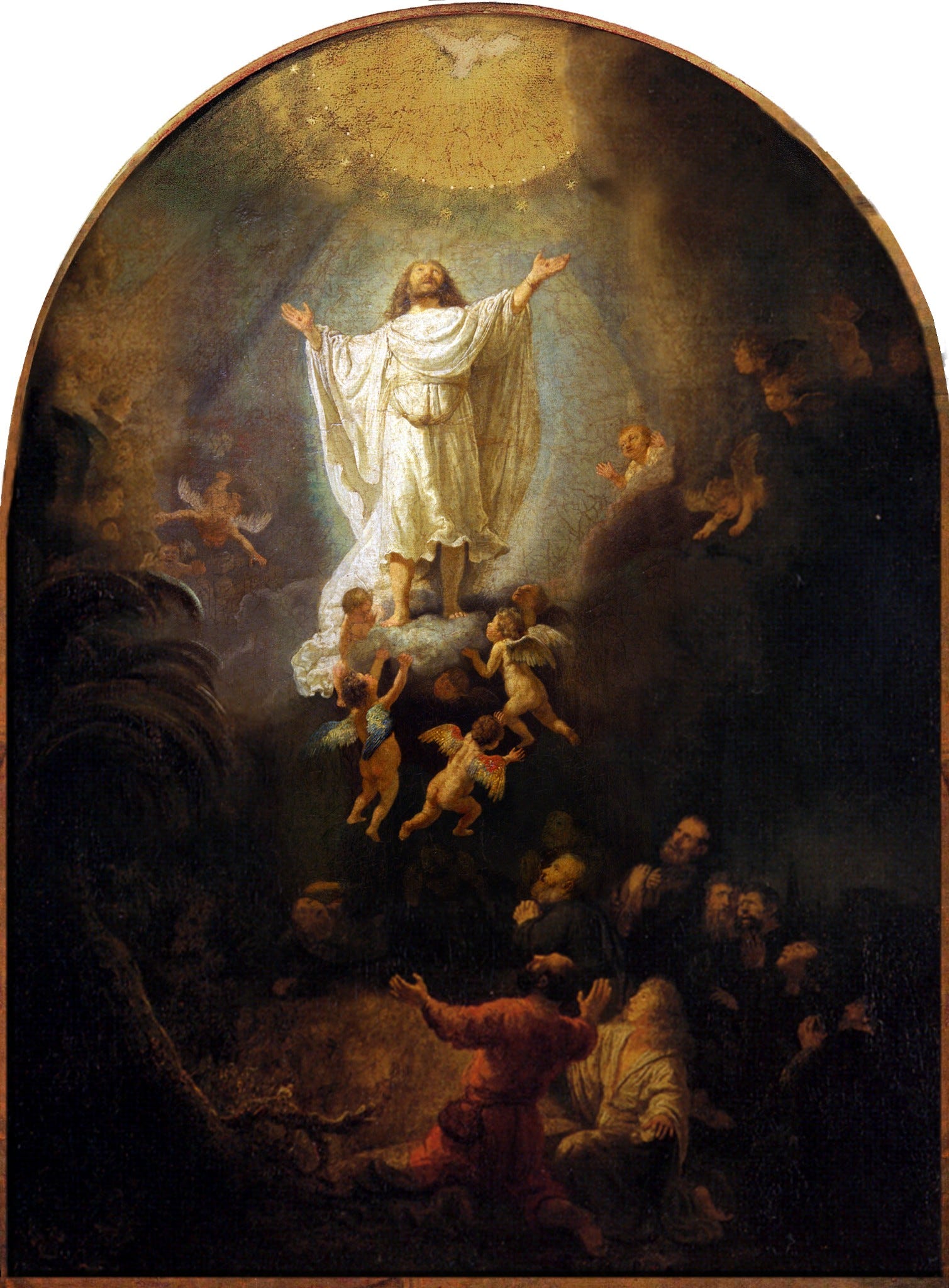
And while they were gazing into heaven as he went, behold, two men stood by them in white robes.23 Their question was both a rebuke and a promise:
“Men of Galilee, why do you stand looking into heaven? This Jesus, who was taken up from you into heaven, will come in the same way as you saw him go into heaven.”24
These were not stargazers awaiting escape. They were witnesses who would make way for Jesus’ return. The same Jesus. The same scars. The same voice. But first the gospel of the kingdom would be proclaimed throughout the whole world.
So they returned from the Mount of Olives, a Sabbath day’s walk, back into the city that had crucified Jesus. And they went upstairs to the room where they lodged. The list of their names is deliberately ordinary: Peter and John and James and Andrew, Philip and Thomas, Bartholomew and Matthew, James the son of Alphaeus and Simon the Zealot and Judas the son of James.25 Fishermen, a tax collector, a zealot, a doubter. None were credentialed. None were esteemed.
And with them the women who had followed from Galilee, Mary the mother of Jesus, and His brothers who had once said “He is out of his mind.”26 All these with one accord were devoting themselves to prayer.27 No program. No platform. Only waiting in remembrance of the Lord and his promise.
The men in the upper room did not gather to discuss how the story made them feel. They gathered because the story had actually happened, the tomb was actually empty, and they had seen the risen Jesus with their eyes and touched him with their hands.28 “Does Christianity work?” was beyond their conception. They were there for one reason: they knew it was true.
But truth alone, held at a distance like a map we examine, does not move our feet down the paths it reveals. The men and women in that room already knew the facts. They had seen the proofs. They had heard the command.
And while they waited to be baptized with the Holy Spirit, Peter stood up among the first hundred and twenty, saying:
“Brothers, the Scripture had to be fulfilled, which the Holy Spirit spoke beforehand by the mouth of David concerning Judas, who became a guide to those who arrested Jesus. For he was numbered among us and was allotted his share in this ministry. For it is written in the Book of Psalms,
‘May his camp become desolate,
and let there be no one to dwell in it’; and
‘Let another take his office.’So one of the men who have accompanied us during all the time that the Lord Jesus went in and out among us, beginning from the baptism of John until the day when he was taken up from us—one of these men must become with us a witness to his resurrection.”29
The Holy Spirit spoke, centuries beforehand, the very same spirit they waited upon. They did not view the psalms as just writings of David, but as the voice of the Spirit who spoke by his mouth. And as they had learned from their time with Jesus, the Scripture is something that must be fulfilled.
And this was the last time the old ways were needed, because the Spirit had not yet come upon them. They prayed and cast lots to comission Matthias, as a witness who was with them from the baptism of John.30
The upper room is still the pattern. We do not need a new message. We need the ancient message received until it burns in our hearts. We do not need better strategies for influence. We need men and women who will wait in prayer until the Spirit who raised Jesus from the dead raises something in us that no committee can contain.
The church that brought new life to a failing empire did not do so by seizing the levers of power. It did so by living in confidence that the tomb was empty and the throne occupied and the return certain. And that is still the only faith that can satisfy the longings of a weary age.
And so the story circles back to the hill. The cloud did not take Jesus away from them. It brought Him to the place where he’s at work today.31 The Jesus who suffered, who rose, who ascended, will come back some day in the same way he went. Until then the work He began continues, through every life that bears witness to his transforming power. Return is still promised, patience still required. The ends of the earth are still waiting to hear. What began on a hill outside of Jerusalem will find its conclusion when all is made new.32
We who remember this story stand, in a sense, with those inside it. The question the men in white asked still hangs in the air. Why do we stand looking up or looking back or looking around for some other savior? Why do we try so hard to save ourselves?
“This Jesus, who was taken up from you into heaven, will come in the same way as you saw him go into heaven.”
In the meantime the invitation remains open. Lives are still being transformed. Prayers are still being offered. And the Spirit who was poured out at Pentecost is still the only power that can turn a dying civilization—or a single weary heart—into something that reflects the kingdom of God.
This story has been adapted into a version for kids, which can be found here: The Ascension
Acts 1:1-2
Hebrews 2:14-15, thematic
Romans 3:22-26, thematic
Romans 8:20-22, thematic
Matthew 24:14, thematic
Daniel 2:44, thematic
Acts 1:3
1 Corinthians 15:56-57, thematic
Romans 8:2, thematic
John 20:19
1 Corinthians 15:6
John 21:12-13, thematic
Mark 14:50
Acts 1:4-5
John 18:36, thematic
Acts 1:6
Acts 1:7-8
Romans 5:5
Acts 1:9
1 Corinthians 12:27
John 16:7
Matthew 28:20
Acts 1:10
Acts 1:11
Acts 1:12-13
Mark 3:21
Acts 1:14
1 John 1:1
Acts 1:16-22 (Psalm 69:25, 109:8)
Acts 1:26 (Matthew 3:16-17)
Hebrews 7:25
Revelation 21:5
(All Scripture quotations are from the ESV Bible)
We have that same Spirit living inside us! Hallelujah!