

This story is an adaptation of the following: The Blood that Speaks
Have you ever felt it? That hot, twisty squeeze in your chest when somebody else gets the win you were sure was yours? The solo. The shout-out. The “good job” from the coach that landed on your best friend instead of you.
The very first time that exact feeling showed up in the human story… it didn’t end with a mic drop. It ended with blood on the dirt. And yet—here’s the part that still shocks me every single time—God didn’t walk away from the guy who did the worst thing. He stepped in with mercy before the story was over.
This is the story of the very first siblings: Cain and Abel.
Back when the world was still young and the very first family began to grow, two brothers grew up side by side. Cain worked the ground with strong, calloused hands—planting, weeding, watching green things push through the soil. His little brother Abel stayed out with the sheep, the quiet one, the one who knew every lamb by name.
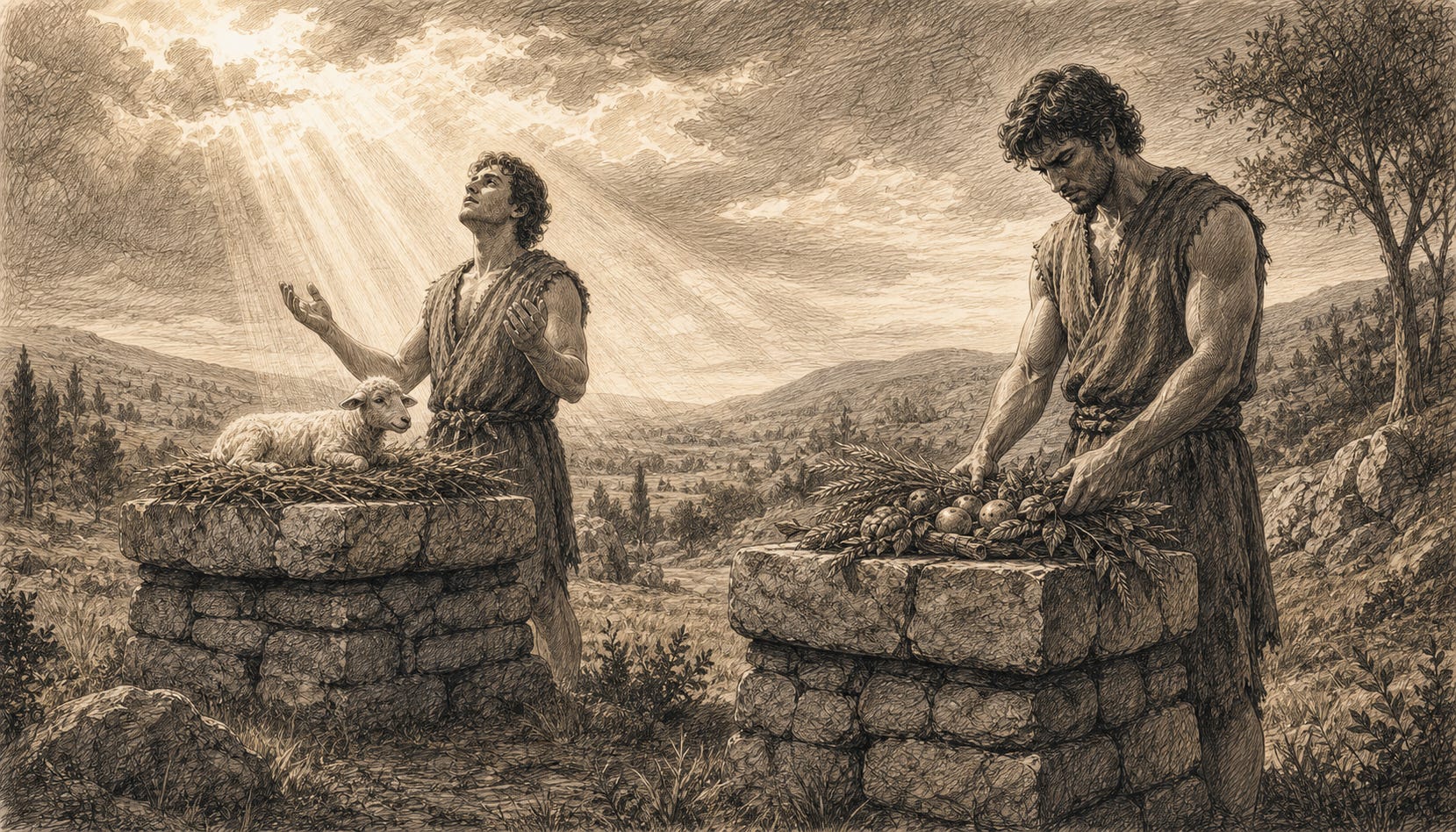
One day both brothers brought gifts to God. Cain brought some of the crops he had grown. Abel brought the very first and the very best lambs from his flock—the ones that mattered most to him.
And God looked at Abel’s gift with joy… but He did not look at Cain’s the same way.
Cain’s face fell. The heat rose in his face like when you open the oven and the hot air gushes out. He was really mad.
God spoke first—before Cain’s anger got him to do anything. He came like a good coach who sees the play developing and calls a timeout:
“Why are you so angry? If you do what’s right, you will be accepted. But watch out—sin is crouching at the door. Its desire is for you… but you must rule over it.”
Sin… crouching at the door.
Not loud. Not waving a flag. Just waiting. Like a cat perfectly still before it pounces. Like that angry song you keep replaying until your fists are tight and your thoughts get mean. It doesn’t stay small. It waits for the moment you’re not watching… and then it jumps.
Cain didn’t listen.
He said to his brother, “Let’s go out to the field.”
And in the open place under the big blue sky, Cain rose up against Abel—his own brother—and killed him.
The ground drank the blood.
God spoke to Cain again, the same way He had spoken to Cain’s parents in the garden of Eden.
“Where is Abel your brother?”
Cain shrugged like it was nothing. “How should I know? Am I my brother’s babysitter?”
God’s voice was steady, but it carried the weight of the whole sky:
“What have you done? Your brother’s blood is crying out to me from the ground.”
The dirt that had received Abel’s blood now refused to give Cain its strength. He would be a wanderer, always moving, never really home. The very ground would be against him.
Cain panicked. “This punishment is too big! Everyone who finds me will kill me!”
And then—listen to this—God did something no one expected.
He put a mark on Cain. A sign that said, “Don’t touch him. He’s under My protection. If anyone kills Cain, he will get seven times revenge.” Even the guy who had just killed his brother got a mark of mercy. God refused to let vengeance have the last word.
Cain went east to a land called Nod and built a city. He named it after his son. And in that city, something surprising happened: people started making things. Tents. Tools. And music—the first songs on lyres and pipes. The image of God—the spark that makes us create and sing and build—was still alive in Cain’s family line.
But the city learned the wrong song.
One of Cain’s descendants, a man named Lamech, started singing a new boast:
“If Cain gets seven times revenge, then I will take it seventy-seven times!”
The tools that could have built beauty were now being sharpened for getting even. The crouching thing had grown up and taught a whole city how to stay angry forever.
But God was not finished.
Adam and Eve had another son—Seth. And Seth had a son named Enosh. And right then, something beautiful started happening: people began to call on the name of the Lord. They prayed. They said, “God, we can’t do this by ourselves. We need You.”
Two roads opened that day in the dust outside Eden.
One road says: “I will build my own city. I will make my own name. I will protect myself with walls and weapons and revenge.”
The other road says: “I’m calling on the Name that is bigger than me. God, I need your help!”
And that second road? That’s the one that still leads home.
Kids, that same crouching sin is still at the door of your heart this week. It shows up when you notice that someone else has more friends, more wins, more spotlight than you do. It whispers, “They don’t deserve it. Say something. Do something. Make them feel as small as you feel right now.” That’s called envy.
It grows when you replay it like a playlist on repeat. And it leads to all sorts of bad decisions, just like it did when Cain killed his brother.
But we have another shepherd that was killed by his envious brothers.
We have Jesus.
Jesus didn’t come to get even. He came to deal with the sin that tricks us and the death that comes from it. His blood on the cross speaks a better word than Abel’s blood ever could. It doesn’t cry, “More revenge!” It cries, “It is finished!” You are forgiven. You don’t have to hide anymore. You don’t have to keep building walls and making excuses.
If we tell God the truth about our mess—“God, I was angry. I wanted to hurt them. I let sin pounce”—He is faithful and just to forgive us and clean up our hearts. That’s not just nice words. That’s the blood of Jesus still speaking over your actual experiences.
So here’s what we do with this story this week:
First, when that hot, twisty feeling starts rising in your chest—before you yell, before you hit, before you say the mean thing—stop. Right there, wherever you are, whisper: “God, I’m being tempted right now. Help me to beat this temptation.” Then choose the next right thing: walk away, say something kind instead, or just breathe and choose to forgive.
Second, use your hands and your words to build someone up instead of tearing them down. Talk to the kid who never gets noticed. Share the win instead of hogging it. Create something that makes someone else feel seen. That’s still the image of God at work in you.
Third, if you’ve already let it pounce—if you’ve hurt someone or hidden something—don’t run away from God. Run to Him. Tell Him the truth. And if you can, apologize to the person you hurt. Jesus wants you to be free of regrets.
And one last thing: the Lord is still asking questions today. Not to trap you. To wake you up.
“Where are you?
Where’s your brother?
What are you going to do with the heart I gave you?”
He’s still inviting you to ask him for help instead of trying to solve your own problems.
Let’s pray:
Heavenly Father,
We know sin is still crouching at the door of our hearts sometimes—
whispering, waiting, wanting to pounce.
Help us rule over it this week instead of feeding it with angry thoughts or mean words.
Thank You, Jesus, that Your blood speaks a better word than Abel’s—
a word that says we are forgiven, we are loved, and we don’t have to hide.
Give us courage to call on Your name when we feel jealous or angry.
Mark us with Your mercy so we can show mercy too.
We love You.
In Jesus’ name, Amen.