

The news began to spread before the dust of the road was washed from Peter’s garments.
The apostles and the brothers who were throughout Judea heard that the Gentiles also had received the word of God.1
Among those brothers was a man they had long called Barnabas, a Levite from Cyprus, whose name meant “son of encouragement.”2 He had been born into a life of service to the Lord.3 The way he served was quiet yet effective.
When the gospel had first begun to spread, Barnabas sold a field and brought the money and laid it at the apostles’ feet.4 He was the kind of man who saw what was needed and did it without fanfare. Now he heard the report from Caesarea the way one hears the opening of a long shut gate: with wonder, and with a quiet, almost nervous, joy.
The Gentiles had received the word!
But some were not excited at the news.
The circumcision party criticized Peter, saying:
“You went to uncircumcised men and ate with them!”5
The charge was accurate. Peter did not answer with annoyance or denial. He explained to them in order— the trance in Joppa, the great sheet lowered by its corners, the voice that had spoken three times:
“What God has made clean, do not call common.”6
He told of the three men who arrived at the very moment the vision ended, and of the Spirit’s command to go without distinction. He told how an angel had stood in a Centurion’s house, and said to send for Peter by name.7
“He will declare to you a message by which you will be saved,” the angel had said, “you and all your household.”8
He spoke of his arrival at Cornelius’ house, and of what had happened when he shared the gospel.
“As I began to speak,” Peter told them, “the Holy Spirit fell on them just as on us at the beginning.”9
Then Peter spoke the words that settled the matter:
“And I remembered the word of the Lord, how he said, ‘John baptized with water, but you will be baptized with the Holy Spirit.’
If then God gave the same gift to them as he gave to us when we believed in the Lord Jesus Christ, who was I that I could stand in God’s way?”10
When they heard these things they fell silent.
The silence lasted longer than expected. But in that silence something was happening. The perspectives of the men began to shift. And Peter let it unfold. He did not try to fill the silence or convince them. He simply let the Spirit do His work.
Through the exchange, Barnabas listened and was filled with joy.
Before Peter’s journey he had taken Saul of Tarsus— then feared by the believers in Jerusalem— and brought him to the apostles, declaring how on the road Saul had seen the Lord and how at Damascus he had preached boldly in the name of Jesus.11 Only after that had Saul moved freely among them.
Barnabas knew the difficulties of opening doors that others preferred to keep shut. Now, in the long silence, he recognized the Spirit moving.
The silence was finally broken when the critics glorified God, saying,
“Then to the Gentiles also God has granted repentance that leads to life.”12
Meanwhile, those who had been scattered by the persecution traveled as far as Phoenicia and Cyprus and Antioch, speaking the word to no one except Jews. But there were some of them, men of Cyprus and Cyrene, who on coming to Antioch spoke to the Hellenists also, preaching the Lord Jesus.13
Antioch was the third city of the empire, a place where Greek and Syrian and Roman and Jew lived in close proximity. Into that city the scattered ones went, and the word began to move among those who had never been to synagogue. And the hand of the Lord was with them, and a great number who believed turned to the Lord.14
The report of this came to the ears of the church in Jerusalem, and they sent Barnabas to Antioch.15
Peter’s story about the Holy Spirit falling on the Gentiles was still fresh in Barnabas’ mind. This was not the first unexpected act of grace. He had vouched for Saul in spite of fear and unbelief.16 And he’d heard that Philip had baptized an Ethiopian official.17 Now he had been dispatched to see what the Lord was doing among the Gentiles in a city far away. He had time to think things over while he travelled; the journey would take him at least two weeks.
When Barnabas arrived in Antioch, he walked among the new disciples. He saw Gentiles who had never kept a Sabbath praying with Jews who had kept every Sabbath of their lives. He heard those who had once lived in competition, together singing songs of joyful praise.
When he came and saw the grace of God, he was glad, and he exhorted them all to remain faithful to the Lord with steadfast purpose, for he was a good man, full of the Holy Spirit and of faith.
And a great many people were added to the Lord.18
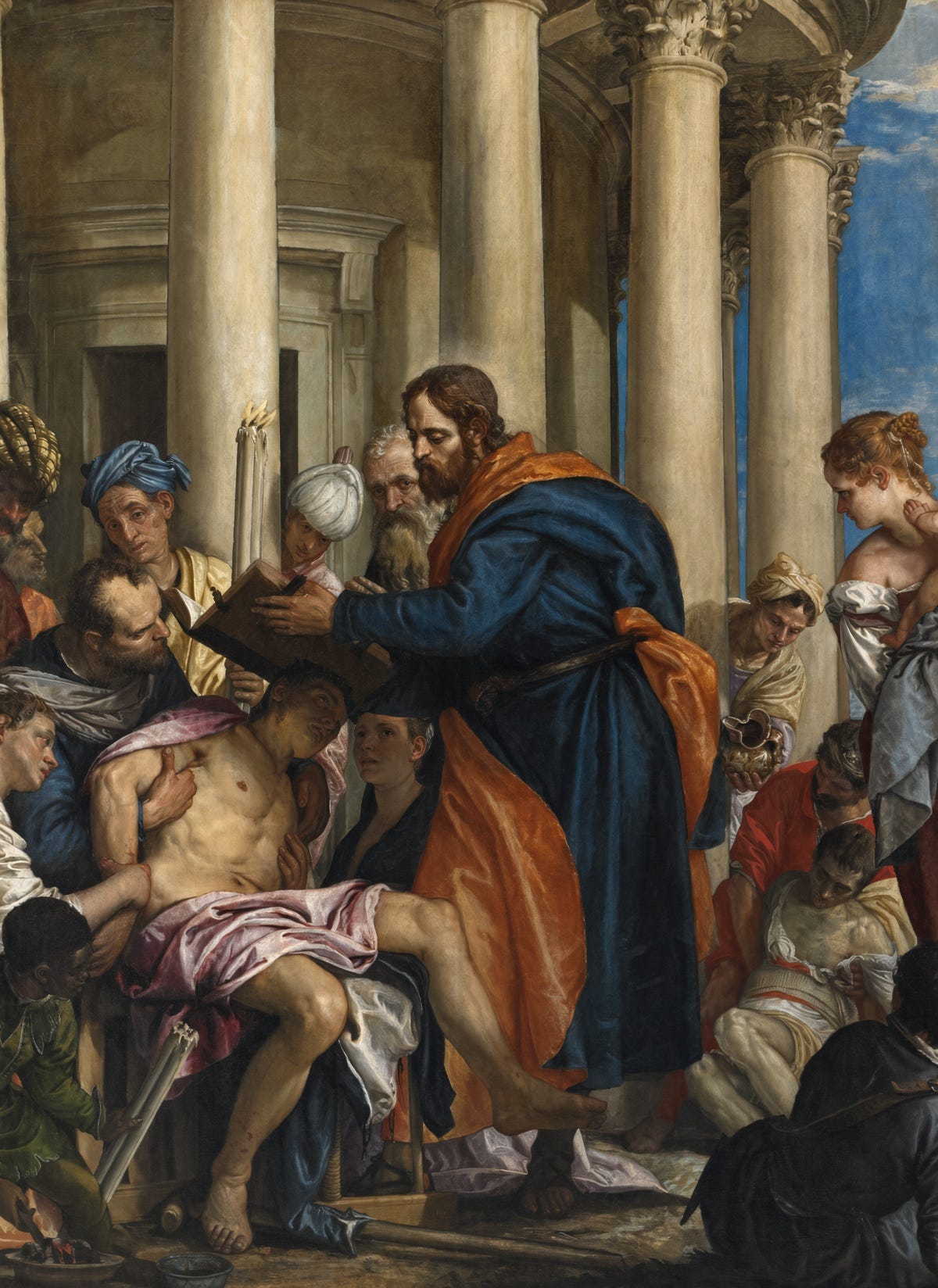
He moved through their gatherings with the awareness of one who had learned to notice those standing at the edges. His encouragement was not vague cheer; it was the steadying presence of a man who trusted the Lord and refused to lean on his own understanding.19
Yet Barnabas saw that the need there was larger than one man’s capacity to strengthen and teach. He remembered Saul. Nearly a decade had passed since the two men had last been together in Jerusalem.20 After that brief, tense visit, Saul had been sent away to Tarsus, and the years had passed as they do— more rapidly than either would have planned.
So Barnabas went to Tarsus to find Saul. When he found him, something in Barnabas settled. He recognized the same zeal he’d seen before, now matured through years of contemplation. Back they went, as reunited friends, to Antioch.21 They had a week to catch up as they walked.
For a whole year they met with the church and taught a great many people.22 They sat with Jews who still felt the pull of old traditions and with Gentiles who were only beginning to learn about the “God of all grace.”23 They taught in public places and in homes. Questions rose that had never been asked in the synagogues of Jerusalem.
Saul’s mind moved like a blade— precise, relentless, revealing the Scriptures in ways that left his listeners longing for more. Barnabas’ presence worked more subtly, steadying the ones who struggled, noticing those who listened quietly, drawing the hesitant into conversation.
Together they formed something neither could have formed alone. There were evenings when the air in the room felt thick with the weight of new creation— a people no longer defined by the places they came from or the gods they had once served, but by the Lord who had been crucified and raised.
The year shaped them both. Saul’s persistent zeal was tempered by Barnabas’ steadiness; Barnabas’ efforts to encourage were sharpened by Saul’s clarity. A new kind of people— united but not uniform— was being knit together with the bonds of grace and truth.
And in Antioch the disciples were first called Christians.24
They did not choose the name to describe themselves. The people of Antioch observed this congregation— Jews and Gentiles sitting at the same tables, praying to the same Lord, breaking the same bread— and made a word to describe the strangeness that they saw. Christians. Those who belong to the Christ.
The name was likely spoken with a touch of distance, even mockery perhaps. Yet it stuck as it was true. Something new had appeared in the world: a people defined not by ethnicity, status, gender or language— but by the Messiah who had conquered sin and death.
During those days prophets came down from Jerusalem to Antioch. One of them, named Agabus, stood up and foretold by the Spirit that there would be a great famine over all the world (this took place in the days of Claudius).
So the disciples determined, every one according to his ability, to send relief to the brothers living in Judea. And they did so, sending it to the elders by the hand of Barnabas and Saul.25
And so the Pharisee, and the Levite who had vouched for his renewal, now returned to Jerusalem with provisions from the Gentile flock in Antioch. These were ordinary things: food, money, the practical donations one gives to those in need. Yet they bore a weight beyond their contents.
For the first time, the flow of mercy was running the other direction: from the nations toward Judea. The gospel to the Gentiles had come full circle.26 The path God had appointed for the scattered disciples had become a two-way street of grace.
The name “Christian” first said in Antioch was only the beginning. In the years to come that name would be spoken in markets and in prisons, as accusation and confession, written in the blood of martyrs and in the endurance of the saints.
Yet it remained what it had been in Antioch: a title for those who found themselves in Christ— the risen Lord who had fulfilled the story of Israel and opened that story to the nations.
The Pharisee bearing gifts from those he’d once vowed to destroy, and a Levite whose portion had always been the Lord, had witnessed divine love sprinkled among the former outsiders. The door had been opened. The name had been given.
And Paul and Barnabas had only just begun.
This story has been adapted into a version for kids, which can be found here: A Story from Acts 11
Acts 11:1
Ref. Acts 4:36
Ref. Numbers 8:10-16
Acts 4:37
Acts 11:2-3
Acts 11:4-10, thematic
Acts 11:11-13, thematic
Acts 11:14
Acts 11:15
Acts 11:16-17
Ref. Acts 9:27
Acts 11:18
Acts 11:19-20
Acts 11:21
Acts 11:22
Ref. Acts 9:26-27
Ref. Acts 8:36-38
Acts 11:23-24
Ref. Proverbs 3:5
Ref. Acts 9:26–30; Galatians 1:18–21. Saul’s first visit to Jerusalem occurred about three years after his conversion (Gal 1:18). He was then sent to Tarsus, the capital of Cilicia (Acts 9:30), and spent years in the region (Gal 1:21) before Barnabas sought him out for the work in Antioch (Acts 11:25–26). Most chronologies place roughly eight to ten years between these two meetings.
Ref. Acts 11:25-26a
Acts 11:26b
Ref. 1 Peter 5:10
Acts 11:26c. The term Christians (Greek Χριστιανός), a latinism meaning “those belonging to the Messiah.” The Latin suffix is typical of how Romans labeled political or partisan groups (Herodians, Caesarians, Pompeians). Antioch was a cosmopolitan Roman city; such labels were common there.
Acts 11:27-30
Ref. Ephesians 3:6-7
(All scripture references are from the ESV bible)