

The claims of the false witnesses still hung in the air.1 The eyes of the council remained fixed on Stephen. And the look on his face— like the face of an angel— had not faded.2
They claimed to have heard him blaspheme against Moses, against God, against the temple and against the law. They said they’d heard him say Jesus would destroy the temple and change the customs that had been delivered by Moses himself!3 The onlookers shifted nervously in their seats. The air in the room felt somehow heavy, and every face bore the look of concern.
The suspense was finally broken by the high priest, who asked:
“Are these things so?”4
Stephen did not attempt to defend himself. He didn’t dispute the credibility of his accusers. “Brothers and fathers, hear me.” He said. And he began to tell a story:
“The God of glory appeared to our father Abraham when he was in Mesopotamia, before he lived in Haran, and said to him, ‘Go out from your land and from your kindred and go into the land that I will show you.’5 Then he went out from the land of the Chaldeans and lived in Haran. And after his father died, God removed him from there into this land in which you are now living.”6
The scribes rolled their eyes. They all knew the story. Each had spent years memorizing the Scriptures. Who did this man think he was? They listened closely for errors in his speech, already starting to form their objections. Yet something in the way he spoke— the calm certainty, the absence of haste— had begun to make them uneasy.
He spoke of the promise to Abraham, a land for his offspring though he had no child.7 And of the prophecy that his offspring would be sojourners in Egypt, enslaved and afflicted for four hundred years.8
“‘But I will judge the nation that they serve,’ said God, ‘and after that they shall come out and worship me in this place.’
And [God] gave him the covenant of circumcision.”9
The promise came first, before circumcision or law. And long before God would be worshipped “in this place.”10
“And so Abraham became the father of Isaac, and circumcised him on the eighth day, and Isaac became the father of Jacob, and Jacob of the twelve patriarchs.
And the patriarchs, jealous of Joseph, sold him into Egypt; but God was with him and rescued him out of all his afflictions and gave him favor and wisdom before Pharaoh, king of Egypt, who made him ruler over Egypt and over all his household.”11
The brother they rejected became ruler over Egypt, and when famine arrived they came looking for grain.12
“And on the second visit Joseph made himself known to his brothers, and Joseph’s family became known to Pharaoh.”13
Joseph delivered the family that had rejected him. They had meant evil, God turned it for good.14 A paradoxical pattern of jealousy emerged: the one sent to save— was first cast away.
The room was quieter now. A few faces had grown grim. The old story was beginning to creep into the present.
Stephen spoke of Moses at greater length, explaining how the people had multiplied and become Pharaoh’s slaves as the Lord said.15 “And Moses was adopted by Pharaoh’s daughter, instructed in wisdom and mighty indeed.”16
“When he was forty years old, it came into his heart to visit his brothers, the children of Israel. And seeing one of them being wronged, he defended the oppressed man and avenged him by striking down the Egyptian. He supposed that his brothers would understand that God was giving them salvation by his hand, but they did not understand.
And on the following day he appeared to them as they were quarreling and tried to reconcile them, saying, ‘Men, you are brothers. Why do you wrong each other?’ But the man who was wronging his neighbor thrust him aside, saying, ‘Who made you a ruler and a judge over us? Do you want to kill me as you killed the Egyptian yesterday?’
At this retort Moses fled and became an exile in the land of Midian, where he became the father of two sons.”17
Another deliverer was rejected by his brothers, with the phrase “who made you a ruler and judge over us?” The council couldn’t deny it, they all knew the story— and it was becoming an indictment of them.
But just as with Joseph, God still worked through Moses. Forty years later, in the wildnerness of Sinai, the Lord spoke to him through the burning bush.18
“When Moses saw it, he was amazed at the sight, and as he drew near to look, there came the voice of the Lord:
‘I am the God of your fathers, the God of Abraham and of Isaac and of Jacob.’ And Moses trembled and did not dare to look. Then the Lord said to him,
‘Take off the sandals from your feet, for the place where you are standing is holy ground. I have surely seen the affliction of my people who are in Egypt, and have heard their groaning, and I have come down to deliver them. And now come, I will send you to Egypt.’”19
The fear that inspired the false accusations now grew into fury as Stephen spoke on. He reminded them that after Moses’ rejection, God made him ruler and redeemer, performing wonders and signs for the next forty years.20
“This is the Moses who said to the Israelites, ‘God will raise up for you a prophet like me from your brothers.’ This is the one who was in the congregation in the wilderness with the angel who spoke to him at Mount Sinai, and with our fathers. He received living oracles to give to us.
Our fathers refused to obey him, but thrust him aside, and in their hearts they turned to Egypt, saying to Aaron, ‘Make for us gods who will go before us. As for this Moses who led us out from the land of Egypt, we do not know what has become of him.’”21
The pattern deepened with each addition. Joseph betrayed to become the redeemer; Moses rejected before freedom came. And jealousy,22 quarrels,23 disobedience24 and idolatry25— among the people God sent them to save.
Something shifted in the room. The more clearly the pattern of rejection was shown, the more the air itself seemed to thicken. What had begun as formal accusation was becoming personal exposure of the accusers. The story Stephen told was not only about the ancestors; it was about those who had rejected Jesus himself. Faces that had been merely attentive now tightened with something akin to alarm.
Then Stephen went on to speak of the temple, which followed the exodus by four hundred and eighty years. Before that a tent had served the same purpose— the temple had been the idea of men.26
“Yet the Most High does not dwell in houses made by hands, as the prophet says,
‘Heaven is my throne,
and the earth is my footstool.
What kind of house will you build for me, says the Lord,
or what is the place of my rest?
Did not my hand make all these things?’”27
The light that had rested on Stephen’s face was now accompanied by the beacon of truth.28 Their exposure brought wrath. Some in the council scowled in outrage. Others clenched their jaws and their fists. The hypocrisy that had driven the slander was revealed. It stood in the open, unclad and uptight.
And Stephen kept speaking:
“You stiff-necked people, uncircumcised in heart29 and ears, you always resist the Holy Spirit. As your fathers did, so do you!
Which of the prophets did your fathers not persecute? And they killed those who announced beforehand the coming of the Righteous One, whom you have now betrayed and murdered, you who received the law as delivered by angels and did not keep it!”30
When they heard these things they were enraged, and they ground their teeth at him.31 The exposure was complete. The jealousy and selfish ambition that had resorted to slander was unmasked.32 The light that had come to reveal heaven’s purpose also revealed the accusers’ true character.33 And the fear of disgrace had become self-fulfilling.
But Stephen, full of the Holy Spirit, gazed into heaven and saw the glory of God, and Jesus standing at the right hand of God. And he said, “Behold, I see the heavens opened, and the Son of Man standing at the right hand of God!”34
The glory was not distant. It pressed into that room, heavy and pure. In other places the Scriptures speak of Christ seated, the sacrifice complete, the victory won. But Stephen saw Him standing— in the ultimate courtroom— the Judge had risen to his feet.35
It hadn’t been long since this very council had falsely accused Jesus, and condemned him, and beat him, and put him to death.
But he had risen.
And he was still standing!
The sin that had tried to stay hidden in darkness now faced an exposure it couldn’t escape. They covered their ears and cried out with a loud voice and rushed together at Stephen.36 Hands that had clenched the arms of chairs now seized the man who must be silenced. They did not deliberate the sentence; it had already been given in the grinding of teeth and the stopping of ears.
Stephen was half-lifted, half-dragged.
His feet found the ground only in brief, fleeting moments. Someone’s elbow struck his ribs. A fist found the back of his head. The air smelled of sweat, hot breath, and the dust that arose in the midst of commotion.
Bystanders parted or were pushed aside. The crowd had become a unified being— a dark, many-legged creature moving with the single purpose of removing the offense.
And the witnesses laid their garments at the feet of a young man named Saul.37 Stones struck flesh with dull, sickening thuds. And as they were stoning Stephen, he called out,
“Lord Jesus, receive my spirit!”38
And falling to his knees he cried out with a loud voice,
“Lord, do not hold this sin against them!”
And when he had said this, he fell asleep.39
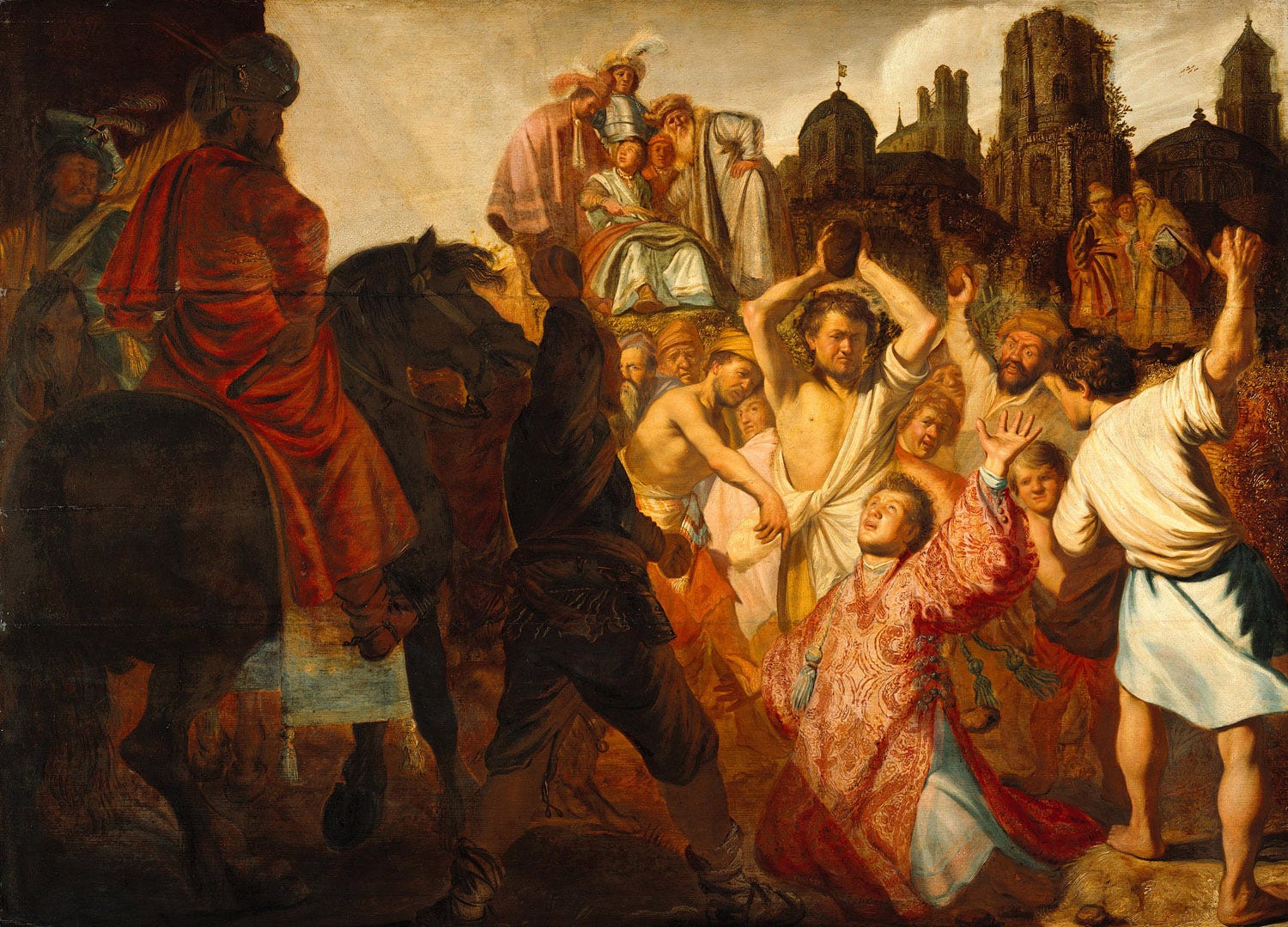
The young man who was watching the garments stood very still. The seed of that day would lie dormant in him, until the time it was destined to sprout. The speech he had heard, the face he had seen, the prayer that rose above the stones— would one day be part of his own defense.40
And on that day a great persecution arose against the church in Jerusalem, and they were all scattered throughout the regions of Judea and Samaria, except the apostles.41 What was meant as an ending, brought new beginnings. And devout men buried Stephen and made great lamentation over him.42
But Saul was ravaging the church, and entering house after house, he dragged off men and women and committed them to prison.43
The pattern that Stephen had traced through the Torah had reached its decisive fulfillment in Jesus. The rejected One had been the true savior, and he was still standing on behalf of his people.
And the fear that had tried to extinquish the light had, in the end, only caused it to spread.
This story has been adapted into a version for kids, which can be found here: A Story from Acts 7
Ref. Acts 6:13-14
Acts 6:15
Ref. Acts 6:11, 13-14
Acts 7:1
Ref. Genesis 12:1
Acts 7:2-4
Acts 7:5 (Ref. Genesis 12:7, 13:15, 15:18)
Acts 7:6 (Ref. Genesis 15:13)
Acts 7:7-8a (Ref. Genesis 15:14, 17:10-14)
Ref. Genesis 17:10-14, (Romans 4:9-12)
Acts 7:8-10 (Ref. Genesis 21:3-4, 37:25-28, 41:38-44)
Acts 7:11-12, thematic
Acts 7:13
Ref. Genesis 50:20
Acts 7:6 (Ref. Genesis 15:13)
Acts 7:17-22, thematic
Acts 7:23-29 (Ref. Exodus 2:11-15)
Acts 7:30 (Ref. Exodus 3:1-4)
Acts 7:31-34 (Ref. Exodus 3:3-10)
Acts 7:35-36, thematic
Acts 7:37-40
Acts 7:9
Acts 7:26
Acts 7:39
Acts 7:40-43
Acts 7:44-47 (Ref. 2 Samuel 7:2-3, 1 Kings 6:1, 8:27)
Isaiah 66:1-2
Ref. John 3:19-21
Ref. Deuteronomy 10:16, 30:6, Jeremiah 4:4
Acts 7:51-53
Acts 7:54
Ref. James 3:16
Ref. John 8:12,44
Acts 7:55-56
Ref. John 5:22, thematic
Acts 7:57
Acts 7:58
Acts 7:59
Acts 7:60
Ref. Acts 22:20
Acts 8:1
Acts 8:2
Acts 8:3
(All scripture references are from the ESV bible)
A brief commentary on the OT. The NT is a commentary on the OT and Revelation is a commentary on the whole Bible. Just like the OT, we are introduced to Saul/Paul in Acts 7 and then the story goes to Philip and back to Paul in Acts 9.