

In the colonnades of the temple, where the great stones still held the warmth of the day’s sun, two men stood speaking to a crowd who had seen a lame man leap for joy. Peter and John had no parchment of credentials, no lineage the powerful recognized. They had only a story and a man who now walked because they had spoken a name over his malformed limbs.1
The people, still bustling from the excitement of Pentecost, had leaned in to listen. Then the guardians arrived— the captain of the temple with his soldiers, the priests in their linen, the Sadducees who had long ago decided that the dead stay dead.2 They came as a coalition of ancient grudges— greatly annoyed at what was being taught— and they took the former fishermen into custody as the sun was setting.3
But many of those who had heard the word believed, and the number of the men came to about five thousand.4
By morning the Sanhedrin had gathered. Annas sat in the high seat; Caiaphas beside him; the elders and teachers of the law filled the chamber like a jury that already knew its verdict.5 The healed man that had been brought in as evidence could not be explained away. The question they put to the defendents was simple and loaded:
“By what power or by what name did you do this?”6
Peter did not hesitate. The Holy Spirit filled him, and the words came with the weight of one who has already died to the old ways of fear:
“Rulers of the people and elders, if we are being examined today concerning a good deed done to a crippled man, by what means this man has been healed, let it be known to all of you and to all the people of Israel that by the name of Jesus Christ of Nazareth, whom you crucified, whom God raised from the dead—by him this man is standing before you well.
This Jesus is the stone that was rejected by you, the builders, which has become the cornerstone. And there is salvation in no one else, for there is no other name under heaven given among men by which we must be saved.”7
The room grew still. These were not the words of one who had spent years carefully climbing the ladders of influence. They were the words of a man who had watched his master die and then seen him alive again, and who now carried in his bones the knowledge that every other foundation was already cracking.8
The council saw their boldness. They noted with astonishment that these were uneducated, common men. And they recognized that they had been with Jesus.9 The healed man stood beside them, undeniable. So they commanded them to leave the council, and conferred with one another, saying:
“What shall we do with these men? For that a notable sign has been performed through them is evident to all the inhabitants of Jerusalem, and we cannot deny it. But in order that it may spread no further among the people, let us warn them to speak no more to anyone in this name.”10
The miracle could not be denied; therefore the messengers must be silenced. They called the apostles back and commanded them not to speak or teach at all in the name of Jesus.11
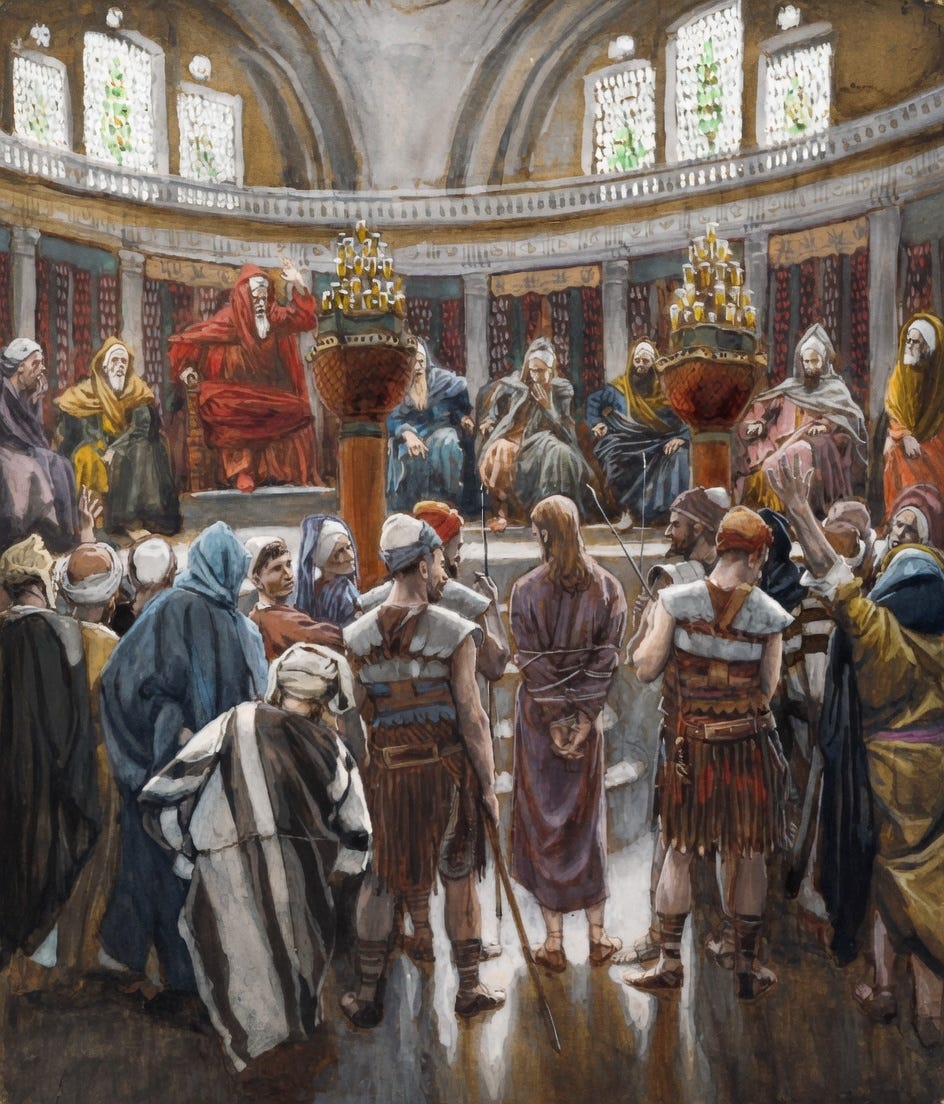
But Peter and John answered with a declaration that has outlived every effort to contain it:
“Whether it is right in the sight of God to listen to you rather than to God, you must judge, for we cannot but speak of what we have seen and heard.”12
One might suppose the disturbance in that room was chiefly intellectual. It was not. The Sadducees, who had built their entire posture upon the denial of resurrection and angels— and the Pharisees, who taught both with fierce precision, had spent decades debating one another.13 The politicians who kept Rome’s favor and the priests who kept the temple’s revenue had their own quiet tensions. Yet on this morning they discovered a unity they had never sought. They were united by the offense of a name that had restored a middle aged beggar and the sight of two fishermen who refused to be afraid.
Unbelief, when examined closely, rarely presents itself as simple absence. It arrives clothed in reasons that change with each generation—reasons that sound unassailable until history discards them. What remains constant is the deeper issue: the refusal to acknowledge that one’s chosen foundation cannot bear the weight of a human soul.
Every person builds. Some build upon moral record and respectability, the steady accumulation of rank that lets a man look himself in the mirror without flinching. Others build upon sophistication— the right books, the refined opinions, the sense of standing above common superstitions. Still others build upon the more fragile securities of affection, achievement, or the body itself through beauty or skill. These become the center from which confidence is drawn and by which others are judged.
When the gospel arrives it does not negotiate for a piece of the structure. It declares the foundation unfit and offers a new cornerstone upon which to rebuild.14
That is why the fishermen’s courage was more than irritating. It was unbearable. They had not earned their certainty through the approved channels. They had received it from a man who had been executed as a criminal and three days later had walked out of his own tomb. Their boldness exposed every other boldness as conditional— dependent upon performance, reputation, or the next turn of circumstance. The leaders could not argue the miracle away, so they tried to intimidate the messengers into silence.
But the messengers resolved that they had already been silenced once— in a garden at night— and they would never be silenced again.
And when they had further threatened them, they let them go, finding no way to punish them, because of the people, for all were praising God for what had happened. For the man on whom this sign of healing was performed was more than forty years old.15
When they were released they returned to their friends and told them everything that had been said. The believers did not respond with strategy or sorrow. They lifted their voices together in prayer. They did not ask for the removal of the threat. They asked for something more radical:
“Sovereign Lord, who made the heaven and the earth and the sea and everything in them, who through the mouth of our father David, your servant, said by the Holy Spirit,
‘Why did the Gentiles rage,
and the peoples plot in vain?
The kings of the earth set themselves,
and the rulers were gathered together,
against the Lord and against his Anointed’16—for truly in this city there were gathered together against your holy servant Jesus, whom you anointed, both Herod and Pontius Pilate, along with the Gentiles and the peoples of Israel, to do whatever your hand and your plan had predestined to take place.
And now, Lord, look upon their threats and grant to your servants to continue to speak your word with all boldness, while you stretch out your hand to heal, and signs and wonders are performed through the name of your holy servant Jesus.”17
They had heard the ancient song and recognized their own moment inside it. They had also heard the rest of that song:
“He who sits in the heavens laughs;
the Lord holds them in derision.”18
They did not pray to be made safe. They prayed to be made unshakeable.
And when they had prayed, the place where they were gathered together was shaken. The timbers groaned, the dust rose, and the Spirit who had come at Pentecost filled them again.
They continued to speak the word of God with boldness.19 The shaking was confirmation. It was a sign that the name they had invoked was weightier than the stones of Jerusalem, weightier than the opposition they faced, weightier than the fear that had tried to silence them.
There is an older shaking that explains this one. On the day Jesus died, the earth itself convulsed. The curtain of the temple tore from top to bottom, the rocks split, and the ground moved as if protesting the weight that had just been placed upon an innocent man.20 That weight was the accumulated debt of a world that had chosen to manage itself apart from its Maker—and of the justice every honest heart longs for when evil runs unchecked. It all came down on Him. He was shaken in a way no other could ever be shaken, so that those who trust Him can stand on ground that cannot be moved.21
Three days later the earth shook again. The stone that sealed the tomb rolled away, not because human hands had pushed it, but because a righteousness stronger than death had risen.22 The grave, which had seemed the final and inescapable shaker of all things, was itself shaken open. The one who had borne the first earthquake now brought the power of the second.
Those who had witnessed both earthquakes could no longer be threatened in the old ways. They had already died to themselves.23 They had already been raised with Christ.24 What remained to lose that had not already been surrendered?25
From that unshakeability a new kind of community was born.
Now the full number of those who believed were of one heart and soul, and no one said that any of the things that belonged to him was his own, but they had everything in common.
And with great power the apostles were giving their testimony to the resurrection of the Lord Jesus, and great grace was upon them all. There was not a needy person among them.26
They sold lands and houses when need arose and laid the proceeds at the apostles’ feet, and it was distributed to each as any had need.27 This was not coerced redistribution; it was the natural overflow of people who had discovered that their true treasure could not be confiscated.28 The perishable, offered in the name of the imperishable, became a kind of alchemy.
What the world counts as security— money, property, status— had already been weighed in the shaking and found wanting. What remained was the word that endures,29 the love that cannot fail,30 and the name above all names.31 Into that they poured their lives and their goods, and the community that resulted astonished even its enemies.
We who read these things from a distance are tempted to treat them as beyond our grasp. They are not!
The same powers still gather when the name is spoken without permission. The same fears still rise in the hearts that have tasted grace yet put weight upon the old, shifting foundations. We pray for the shaking to stop—fix the finances, secure the belongings, silence the critics—when the deeper prayer is the one the early believers prayed:
Grant us boldness rooted in what cannot be shaken.
The Lord still answers that prayer, sometimes with an inner quake that makes the outer ones feel somehow smaller.
The measure of whether we have truly heard is not the absence of fear but the presence of a courage that keeps speaking when speaking is costly. And a generosity that treats possessions as already belonging to the coming kingdom.
It is the strange ability to look at those who oppose us and remember that we ourselves were once trapped in the same refusal, until the one who was shaken for us extended his hand and raised us up. The prayer he prayed from the midst of that earthquake persists: “Father, forgive them, for they know not what they do.”32
And so the story continues. The apostles kept speaking. The believers kept sharing. The Sanhedrin kept meeting. And the name that will never again be buried kept spreading— through the cracks in every foundation that tried to stand without him.
The world still shakes. The stone the builders rejected still stands. And those who build on Him discover, often to their own surprise, that they have been given something that nothing can shake and no one can silence: the power to testify boldly to what they have witnessed, and the freedom to give what they cannot keep.
This story has been adapted into a version for kids, which can be found here: A Story from Acts 4
Acts 3:6
Ref. Matthew 22:23, Mark 12:18, Luke 20:27, Acts 23:8
Acts 4:1-3
Acts 4:4
Acts 4:5-6
Acts 4:7
Acts 4:8-12
Ref. 1 Corinthians 3:11
Acts 4:13
Acts 4:16-17
Acts 4:18
Acts 4:19-20
Ref. Acts 23:7-8
Acts 4:11
Acts 4:21-22
Psalm 2:1-3
Acts 4:24-30
Psalm 2:4
Acts 4:31
Matthew 27:51
Ref. Hebrews 12:28
Matthew 28:2
Galatians 2:20
Ephesians 2:6
Ref. Luke 14:33
Acts 4:32-34
Acts 4:35
Ref. Matthew 6:19-21
Ref. 1 Peter 1:24–25
Ref. 1 Corinthians 13:8
Ref. Philippians 2:9
Luke 23:34
(All Scripture quotations are from the ESV Bible)