

There was once a man who had never felt the soft ground against the soles of his feet. In the days when the temple still stood upon its height, its stones warmed by the morning light and its gates open to the footsteps of those who came to pray, he was lifted each morning from his mat and carried through the narrow streets.
They set him down between the same two pillars at the gate called Beautiful, where the stream of worshippers passed through on their way into the courts.1 The bowl between his knees was always the same bowl. The words he spoke had been the same for many years. And the faces that went past him bore the same expressions they always had.
He had learned the sound of sandals on the path long before he’d learned to beg. He knew the difference between the hurried step of a merchant and the measured tread of a priest. He knew the scent of incense drifting from the inner courts and the heavier smell of burnt lamb that followed the morning sacrifice.
Sometimes, when the wind turned, he caught the sound of singing from within the walls, a melody that seemed to belong to another world. He did not resent the music. He had long since come to terms with the reality that he did not belong inside— and that he would never dance.
Not every affliction carried a prescribed ritual in the scrolls of the law, yet the law itself was a tutor,2 pointing toward mercy, toward wholeness, toward the One who would one day gather the outcasts and heal the brokenhearted.3 The Levitical code did not hand down a ritual for crippled limbs as it did for diseased skin.
His parents had prayed for him when he was small, lifting his still legs toward the heavens in hope that the God who had made all things might yet unmake their grief. But after forty years4 their hope had grown dim and their prayers had long since turned towards other things.
On this particular afternoon the light lay long across the portico. The stones were warm beneath him, and the air carried traces of salt from the distant sea mixed with the dust of many feet. Two men came along the path that led from the city.5 Their garments were travel-stained, their sandals worn thin at the heel. They did not walk like men who had come to be noticed. They slowed as they drew near the place where the beggar lay.
And so the beggar did as he had always done. He asked to receive alms.6
The man did not reach for a purse. He did not quicken his pace to pass by on the other side. He simply stopped and looked at the man on the ground with the steady gaze of one who had already seen beneath the surface.
“Look at us,” he said.7
The words were not loud. They did not carry the tone of condescension that the beggar sometimes heard from those who gave. They were an invitation. The man who had spent his life looking at passing knees— now lifted his face. For once he gave the whole of his attention. He saw eyes that had known weariness and had not grown hard. He saw hands that were gentle even though they were calloused. And in that moment something deeper than his careful habits of survival stirred in him.
Then the man said the last thing he had expected to hear: “I have no silver and gold, but what I do have I give to you. In the name of Jesus Christ of Nazareth, rise up and walk!”8
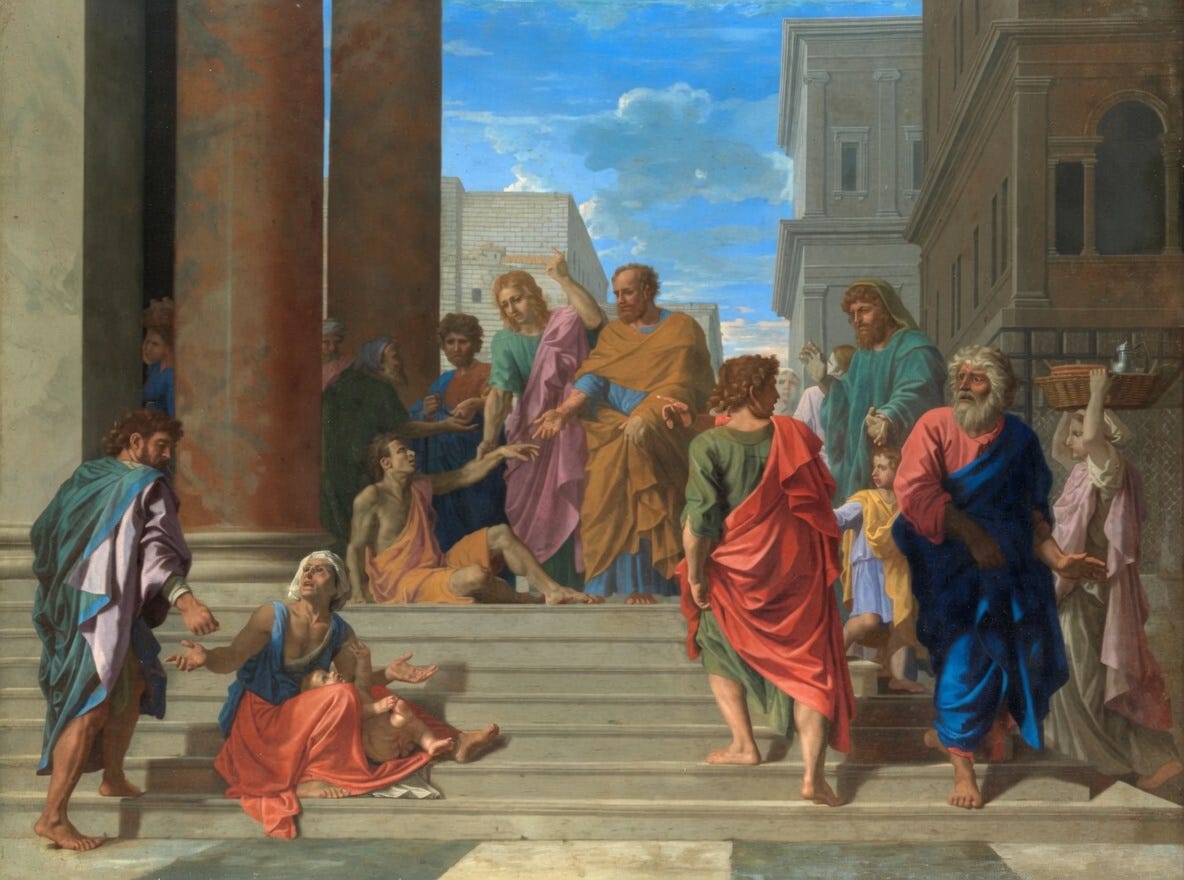
There are gifts that can be weighed and counted, and there are blessings that arrive without measure and beyond expectation. The man on the ground had asked, as he asked every day, for the small mercy that would help him survive inside the story he had always known. What was offered was not an improvement upon that story. It was an invitation out of it.
He took the hand that was extended. He did not know why he chose to take it. Perhaps it was the steadiness of the gaze. Perhaps it was the confidence in the man that had no money to give yet spoke as though he possessed everything.9 The hand closed around his own. And a vigor that did not belong to the tendons of his legs or to the will he had trained to endure moved through him like lightning moves across the sky.
The man raised him up.10 His ankles, which had never borne the effort of standing, found their strength in a single instant. His legs, which had never pushed against the earth, discovered how to do so in a moment. He did not test the ground with caution.
He leapt!
The sound that broke from him was not the gratitude of one who had simply been helped. It was the unpracticed cry of one who’d been awakened from a dismal dream. He went with the two men into the temple courts, walking and leaping and praising God.11
And all the people saw him walking and praising God, and recognized him as the one who sat at the Beautiful Gate of the temple, asking for alms. And they were filled with wonder and amazement at what had happened to him.12 They ran together, astonished, as though the very stones beneath their feet had shifted.
And into that gathering the man Peter who had spoken at the gate began to speak again.
“Men of Israel, why do you wonder at this, or why do you stare at us, as though by our own power or piety we have made him walk?”13
He told them that the God of Abraham, the God of Isaac, and the God of Jacob, the God of their fathers, had glorified his servant Jesus. That they had delivered him over and denied him, even when the Roman governor had decided to release him.14
“But you denied the Holy and Righteous One, and asked for a murderer to be granted to you,” he said, “and you killed the Author of life, whom God raised from the dead. To this we are witnesses”15
“And his name—by faith in his name—has made this man strong whom you see and know, and the faith that is through Jesus has given the man this perfect health in the presence of you all.”16
The man who now stood heard these words while his legs still trembled with the strangeness of their strength. He had come to the gate that morning asking for alms to survive another day inside the same old story. The silver and gold he had once thought would be enough now seemed like a handful of stones beside the blessing that this name had brought.
What he had needed was not a better arrangement for his helplessness but an invitation out of it. And the power had come, not because he had earned it, but because the Lord Jesus had already walked the path no other could walk17 and had been exalted with the name above all names.18
Peter went on:
“And now, brothers, I know that you acted in ignorance, as did also your rulers. But what God foretold by the mouth of all the prophets, that his Christ would suffer, he thus fulfilled. Repent therefore, and turn back, that your sins may be blotted out, that times of refreshing may come from the presence of the Lord, and that he may send the Christ appointed for you, Jesus, whom heaven must receive until the time for restoring all the things about which God spoke by the mouth of his holy prophets long ago.”19
The healed man listened while the words moved over him like water over parched ground. His deepest wound had never been the legs that would not move. It was the heart that had learned to live inside a story where mercy was measured out in coins and hope was not for him from whom most faces turned away. But his was not the only weary heart. The name that had called the man’s legs to remember their purpose was also calling something else to rise.
He listened to the words:
“Moses said, ‘The Lord God will raise up for you a prophet like me from your brothers. You shall listen to him in whatever he tells you. And it shall be that every soul who does not listen to that prophet shall be destroyed from the people.’20
And all the prophets who have spoken, from Samuel and those who came after him, also proclaimed these days. You are the sons of the prophets and of the covenant that God made with your fathers, saying to Abraham, ‘And in your offspring shall all the families of the earth be blessed.’21
God, having raised up his servant, sent him to you first, to bless you by turning every one of you from your wickedness.”22
There are those who say that such stories belong to a simpler time, when people still believed the ordinary order of things could be interrupted by a voice from beyond it. But the man who had been carried every morning of his life knew that the limits he had known had never been the whole truth. Peter had not come to negotiate with those limits. He had come to call the limits into question, and to break them with the name that broke the grave.
The man did not return to the same patch of stones outside the gate. Those who had carried him now walked beside him in the morning. The bowl that had held the day’s small mercies was left behind. What he had been given could not be taken back, and he was now a witness to a new kind of walking.23 The name that had been spoken at the gate had not brought him money. It had given him a new story, legs that leaped, and knees that kneeled to pray.
He walked among the pillars while the evening sacrifice was prepared. He leapt again, not because he needed to prove anything, but because his heart was full of joy. In that leaping the ancient promise and the present moment and the future restoration were held together in a single inarguable sign.
The old serpent’s story had been crushed.24 The cross had proven it untrue.25 And the One who had defeated death was even then seated at the right hand of the Father,26 upholding all things27 until the day when the eyes of the blind shall be opened, and the ears of the deaf unstopped; then shall the lame man leap like a deer, and the tongue of the mute sing for joy.28
The crowd that had gathered would later become a people who carried the name of Jesus into other gates and other cities. Some of them would themselves be carried before their stories ended.29 Some would be beaten and imprisoned for speaking the name that had made the lame man leap. But the power that came through them did not depend upon their strength.
And the man who had been lame from birth now stood among them, his restored legs still learning the rhythm of walking; his heart learning the deeper rhythms of praise. The story he now carried in his bones was the same story they all carried with their lives: the long line of prophecy had begun to find fulfillment, the Author of life had been raised, and the new story he was writing would one day fill all hearts with praise.30
This story has been adapted into a version for kids, which can be found here: A Story from Acts 3
Acts 3:2, thematic
Ref. Galatians 2:24-25, NKJV
Psalm 147:2-3
Acts 4:22
Acts 3:1, thematic
Acts 3:3
Acts 3:4
Acts 3:6
Ref. 2 Corinthians 6:10
Acts 3:7
Acts 3:8
Acts 3:9-10
Acts 3:12
Acts 3:13
Acts 3:14-15
Acts 3:16
The Via Dolorosa, ref. John 19:16-17
Philippians 2:9
Acts 3:17-21
Deuteronomy 18:15–19
Genesis 22:18
Acts 3:22-26
Ref. 1 John 2:6
1 John 3:8, thematic
Romans 5:8, thematic
Ref. Hebrews 10:12
Ref: Hebrews 1:3
Isaiah 35:5-6
Ref. John 21:18
Ref. Revelation 5:13
(All Scripture quotations are from the ESV Bible, unless otherwise specified)
The Story continues here:
Unshakeable

In the colonnades of the temple, where the great stones still held the warmth of the day’s sun, two men stood speaking to a crowd who had seen a lame man leap for joy. Peter and John had no parchment of credentials, no lineage the powerful recognized. They had only a story and a man who now walked because they had spoken a name over his malformed limbs.