

Peter was on the housetop in Joppa when the hunger first took hold of him.1 The house belonged to Simon the tanner, and the smell of the soaking vats rose in the warm air mixed with the sharper tang of the sea.2 Below, the household was preparing the midday meal. He had gone up for a noontime prayer and was kneeling on the flat roof with the sun already high and the city spread beneath him; the narrow streets, the low houses, and the glimmering horizon of the Mediterranean Sea.
He had been summoned there from Lydda, a distance of half a day’s walk, to comfort those who mourned for Tabitha.3 Nobody had expected her return to the living, but Peter had presented her alive.4 The miracle became known throughout all Joppa, and many believed in the Lord.
And Simon had invited him to stay.5
He had grown used to the rhythms of this coastal town, yet something in him remained unsettled. The Lord had risen and ascended. The Spirit had come as promised. The gospel had begun to transform those who heard it. Still the old customs held a part of him, the careful distinctions he had carried since boyhood between clean and unclean, between those who belonged at his table and those whom tradition turned away.
And he became hungry and wanted something to eat, but while they were preparing it, he fell into a trance.6
He saw the heavens opened and something like a great sheet descending, being let down by its four corners upon the earth. In it were all kinds of animals and reptiles and birds— creatures he had been taught from childhood never to touch, never to eat, never to even consider as clean.7
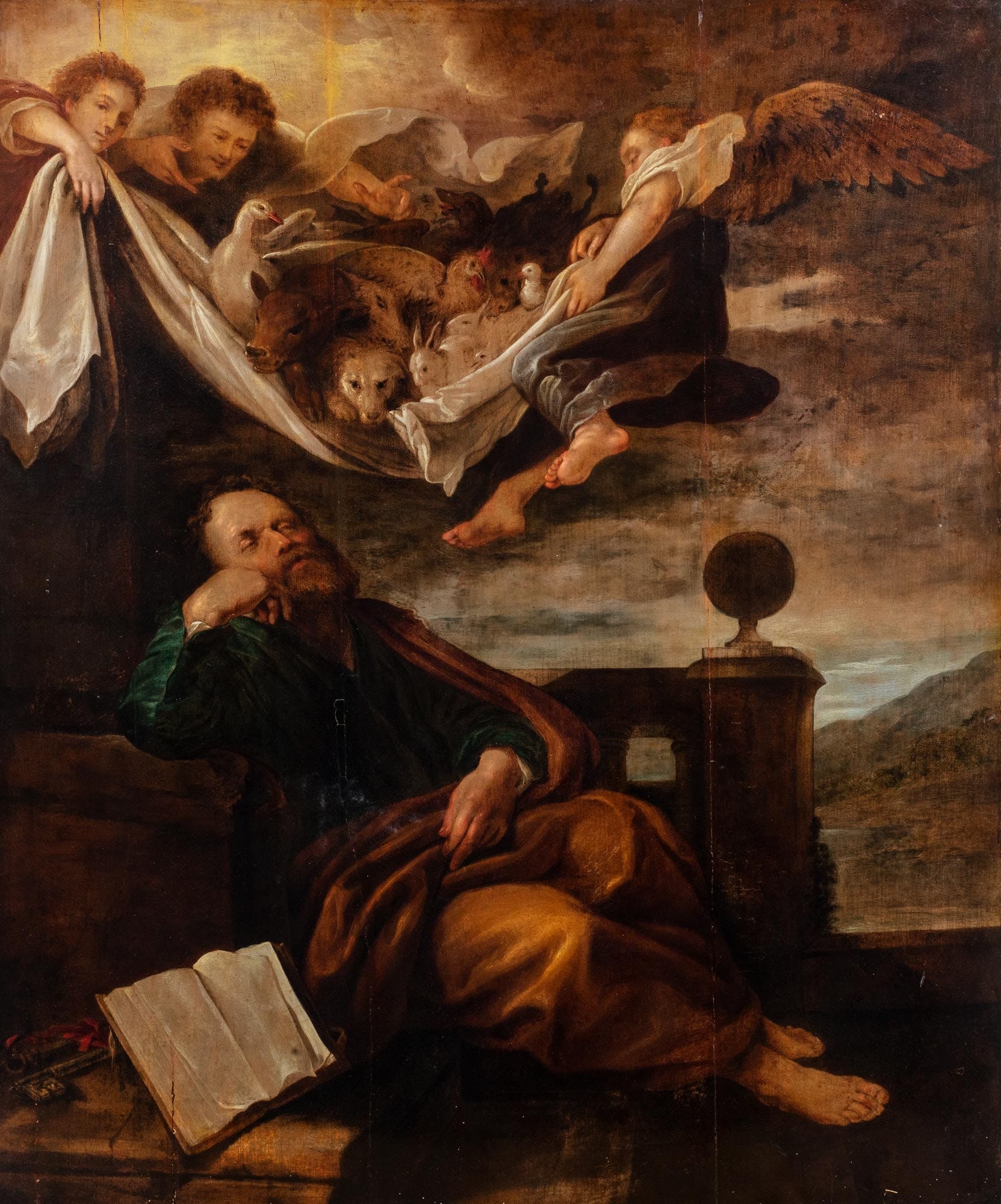
And there came a voice to him: “Rise, Peter; kill and eat.”8
The refusal rose in him at once, out of a lifetime of habit.
“By no means, Lord; for I have never eaten anything that is common or unclean!”9
The voice came a second time, more firmly:
“What God has made clean, do not call common.”10
This happened three times. Three times the sheet was lowered. Three times the command was spoken. Three times he answered from the depths of the story he had always believed. Each repetition of the voice pressed against the settled order of his world. Then the thing was taken up at once to heaven, and he was left alone on the rooftop with the sound of the sea and the weight of a command he did not understand.11
He remained there, inwardly perplexed as to what the vision might mean.12 The categories that had ordered his days— acceptable and detestable,13 insiders and outsiders, Jew and Gentile— had been shaken, yet he could not see where the shaking would lead. His hunger persisted, but it was no longer central. Something more pressing had entered his mind.
While he was still pondering the vision, the Spirit said to him,
“Behold, three men are looking for you. Rise and go down and accompany them without hesitation, for I have sent them.”14
He went down. At the gate stood three men who had traveled from Caesarea; a roman soldier, along with two servants.15
“I am the one you are looking for,” Peter told them. “What is the reason for your coming?”16
And they said, “Cornelius, a centurion, an upright and God-fearing man, who is well spoken of by the whole Jewish nation, was directed by a holy angel to send for you to come to his house and to hear what you have to say.”17
So he invited them in to be his guests. The next day he rose and went away with them, and some of the brothers from Joppa accompanied him.18 The road from Joppa to Caesarea was a two day journey, yet for Peter it passed like a dream as he pondered what had happened.
Every step carried the memory of the sheet and the voice that would not let him call “common” what God had declared clean. He walked with a tension he could not yet name; between the world he had always known and the new creation that was even now occurring around him.
On the following day they entered Caesarea. The Centurion Cornelius was expecting them and had called together his relatives and close friends. When Peter entered the house, Cornelius met him and fell down at his feet and worshiped him.19
But Peter lifted him up, saying, “Stand up; I too am a man!”20
They went inside together and found many persons gathered.21 Peter looked at the faces; Roman soldiers, Gentiles, servants— people he had been taught to keep at a careful distance— and the command pressed against him in a new way. So he shared the truth his vision had revealed:
“You yourselves know how unlawful it is for a Jew to associate with or to visit anyone of another nation, but God has shown me that I should not call any person common or unclean. So when I was sent for, I came without objection. I ask then why you sent for me.”22
Cornelius answered with careful honesty:
“Four days ago, about this hour, I was praying in my house at three o’clock, and behold, a man stood before me in bright clothing and said,
‘Cornelius, your prayer has been heard and your alms have been remembered before God. Send therefore to Joppa and ask for Simon who is called Peter. He is lodging in the house of Simon, a tanner, by the sea.’
So I sent for you at once, and you have been kind enough to come. Now therefore we are all here in the presence of God to hear all that you have been commanded by the Lord.”23
The room grew quiet. A fisherman from Galilee and a centurion of the Empire, a small company of Jewish believers and a household of Gentiles, together under the same roof. The old lines had not been erased, but they had been crossed. Peter felt that crossing in his body—the strangeness of it, the lingering resistance, the growing recognition that the voice on the rooftop had meant exactly what it said.
He looked at Cornelius and saw a man already devout, already generous, already prayerful—one of the best by any ordinary measure.24 And still the angel had come. Still the message was required. The character of the man did not remove the need for the gospel that Peter was commissioned to declare.
So Peter opened his mouth and said:
“Truly I understand that God shows no partiality, but in every nation anyone who fears him and does what is right is acceptable to him.
As for the word that he sent to Israel, preaching good news of peace through Jesus Christ (he is Lord of all), you yourselves know what happened throughout all Judea, beginning from Galilee after the baptism that John proclaimed: how God anointed Jesus of Nazareth with the Holy Spirit and with power. He went about doing good and healing all who were oppressed by the devil, for God was with him.
And we are witnesses of all that he did both in the country of the Jews and in Jerusalem. They put him to death by hanging him on a tree, but God raised him on the third day and made him to appear, not to all the people but to us who had been chosen by God as witnesses, who ate and drank with him after he rose from the dead.
And he commanded us to preach to the people and to testify that he is the one appointed by God to be judge of the living and the dead. To him all the prophets bear witness that everyone who believes in him receives forgiveness of sins through his name.”25
While Peter was still saying these things— while thoughts of death and resurrection hung in the air— the Holy Spirit fell on all who heard the word.26
He came without warning and without restraint, and filled the room with his presence. The believers from among the circumcised who had come with Peter were amazed, because the gift of the Holy Spirit was poured out even on the Gentiles. For they were hearing them speaking in tongues and extolling God.27
The voices rose in languages the speakers had not learned, and beneath the words was something unmistakable: Praise.
Not the measured gratitude of the religiously careful, but the open, astonished adoration of those whose center had shifted. The loving God had become the thing they cherished above all.28
Peter felt the force of it in his chest. This was the same Spirit who had come upon them in Jerusalem. This was the same sign that had once shown that no language and no culture held a privileged claim on the kingdom of God.29 Now it was given again, in a Roman centurion’s house, upon people he had always seen as outsiders.
The amazement of his Jewish companions was more than surprise. It was the shift of something deeper. The dividing wall of hostility was being dismantled in real time.30 What had begun on the rooftop was now completed in that room.
Peter looked at them— the Gentiles speaking in foreign tongues, their faces turned upward in praise— and the last resistance in him gave way. The Lord who had spoken three times on the housetop had fully convicted Peter, who declared,
“Can anyone withhold water for baptizing these people, who have received the Holy Spirit just as we have?”31
No one answered. There were no objections left to give. The silence persisted for a moment, heavy with recognition. Then he commanded them to be baptized in the name of Jesus Christ. And in turn, they asked him to remain for some days.32
Peter stayed. In the days that followed, the house that had been marked by Empire and Gentile custom began to bear the marks of renewal and the lingering wonder of the Holy Spirit. Outside, the sea kept its ancient rhythm against the shore. Inside, new creation was taking visible shape: a people from every nation, accepted not because of what they had achieved or inherited, but because the One who shows no partiality33 had sought them, spoken over them, and had sent His Spirit into each of their hearts.34
The initiative had never belonged to either man. Cornelius had not been searching; Peter had not decided to cross the boundaries himself.
The Lord had set the stage for them.
Even the best of men still need the gospel that brings salvation to everyone who believes.35 Even the most carefully kept traditions must yield when the Lord commands “rise and go!”
The Spirit does not come abstractly. He arrives through the announcement of the crucified and risen Jesus— who was hung on a tree, raised on the third day, and who appeared to those who ate and drank with him— and through whom we are set free indeed.36
That house by the sea was never the same.
The sheet had descended.
The Spirit had come.
And even outsiders were adopted as sons.37
This story has been adapted into a version for kids, which can be found here: A Story from Acts 10
Ref. Acts 10:9
Ref. Acts 10:6
Ref. Acts 9:38
Ref. Acts 9:39-41
Ref. Acts 9:42-43
Acts 10:10
Acts 10:11-12
Acts 10:13
Acts 10:14
Acts 10:15
Acts 10:16, thematic
Acts 10:17
Ref. Leviticus 11
Acts 10:19-20
Ref. Acts 10:7
Acts 10:21
Acts 10:22, (Ref. Acts 10:1-8)
Acts 10:23
Acts 10:24-25
Acts 10:26
Acts 10:27, thematic
Acts 10:28-29
Acts 10:30-33 (Ref. Acts 10:3-8)
Ref Acts 10:1-2
Acts 10:34-43
Acts 10:44
Acts 10:44-46
Ref. 1 John 4:16
Ref Acts 2:4-12
Ref. Ephesians 2:11-16
Ref Acts 10:47
Acts 10:48
Ref. Acts 10:34, Romans 2:11, Galatians 2:6, Ephesians 6:9, Colossians 3:25
Ref. Galatians 4:6
Ref. Romans 1:16
Ref. John 8:36
Ref. Ephesians 1:3-6
(All scripture references are from the ESV bible)
The Story continues here:
First in Antioch

The news began to spread before the dust of the road was washed from Peter’s garments.
Yes. It was "unclean" to dine with the gentiles. Now, Jew and gentile can eat bacon at the same table. Jewish culture was to only dine with Jews. It's hard to abandon cultural norms.
Awesome. Now we can have bacon with eggs for breakfast.